Most AI systems today maintain memory and context within their systems, while platform agents understand what you do inside their platform. Neither understands the person as a whole.
Alfred is my attempt to build the missing layer for the agent-first internet: a user-owned agent grounded in a structured, evidence-backed cognitive model of the individual.
Thesis
The agent-first internet is forming. Alexa for Shopping, Walmart Sparky, Gemini Spark, Slackbot are examples of platform owned agents that are hosted in common platforms and they act on behalf of their users within those platforms. In this world, users will increasingly abstract away from operating and navigating websites/apps/tools, towards specifying intent (decide, research, write, plan, buy, coordinate, organize), while agents assemble relevant user context, reason across options and execute delegated tasks. The durable layer beneath that interface is a continuously updated context substrate that tells an agent who the user is, what they care about, what constraints they operate under, and what authority it has to act. My vision of the agentic internet is one that involves two types of agents: platform owned agents (which deeply understand the platform, its catalog and operations), and user owned agents (which deeply understand the individual user). My focus is on the latter, and my goal is to develop the ideal control plane designed for deep user understanding, intent specification, and user-agent interaction involving training/delegation/approval.
The problem
Platform owned agents are trained on platform-data, accumulate platform-specific user insight, and optimize platform outcomes. This creates a structural problem — each agent knows a different aspect of you, but none understands you holistically. For example, a travel website's agent may understand your hotel or flight booking patterns, but not that you are into swimming or cooking. A streaming service's agent might build your taste profile based on search/browse behavior within its platform, but have no awareness about movies you watched in the theater or books you have read. As a result, every delegation involves friction in the form of detailed specification. The missing layer is a user owned agent that understands you deeply and broadly, and knows your subtle, underlying quirks/preferences — the way your mom or best friend does.
Frontier labs do offer memory and data connectors that attempt to source horizontal context, but these are lossy and unstructured by design: they store raw text and retrieve chunks via vector similarity (RAG), then summarize and compact older text as the context window fills. Through these repeated compression cycles, nuance gets lost. For example, "4.0 level club tennis player using a Wilson Blade racquet with single-handed backhand and aggressive baseline play" gets reduced to simply "plays tennis." These LLMs also do not actively model the user's personality, behavior, aspirations, motivations, morals, needs, fears, values, constraints, decision style, communication patterns and tastes.
The product
Alfred is designed around four connected components.
1. Your Data
The user connects selected parts of their digital life that already contain evidence about them. The current product supports sources including Google account data, LLM memory and résumé documents. The broader architecture is designed to incorporate sources such as email, calendars, contacts, professional profiles, notes, photos, health records and social activity.
The purpose is not to assemble a permanent archive for an AI to search indiscriminately. The source data provides evidence from which a more useful model can be constructed.
2. Your Identity
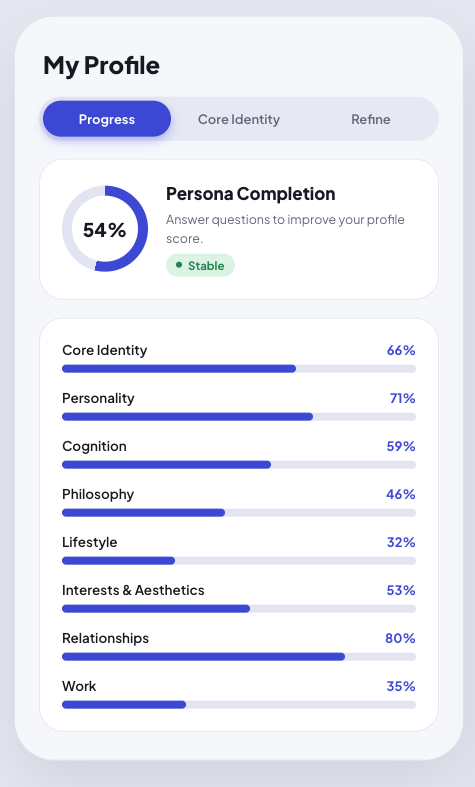
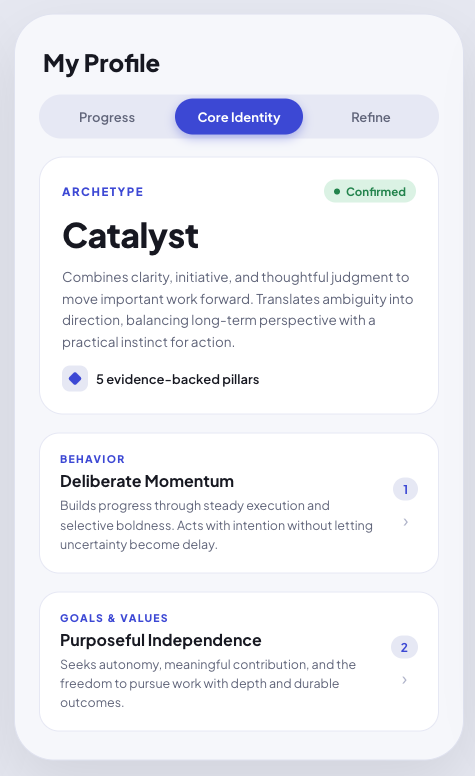
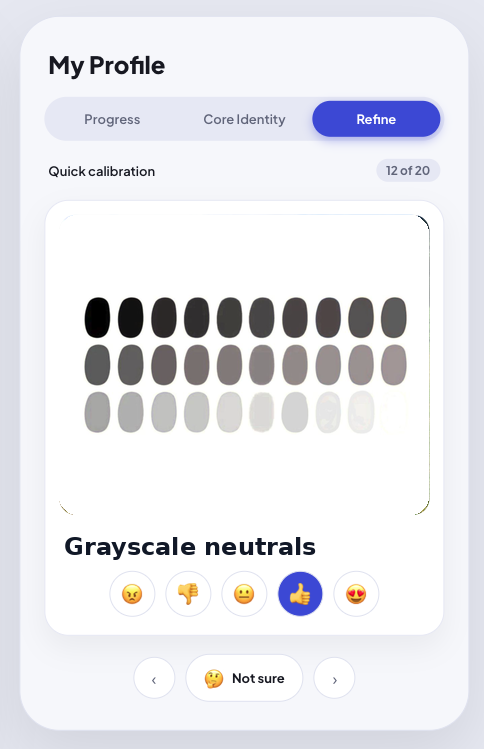
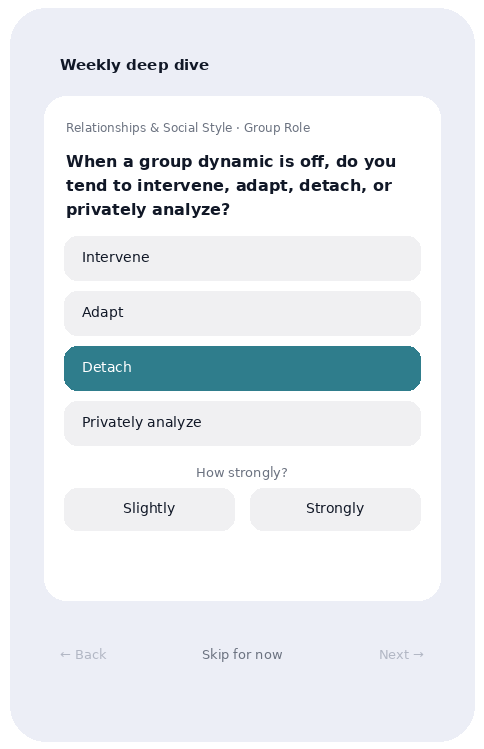
Alfred converts source evidence into atomic claims and then synthesises those claims into a structured identity model. The model covers attributes across areas such as behaviour, cognition, goals, taste and preferences. Important inferences retain their provenance, confidence, timestamps and links to relevant people or entities. The user can inspect what Alfred believes, understand why it believes it and correct it when it is wrong — through chat or specific user fine-tuning UX. This makes the identity model different from both a hidden advertising profile and an unstructured collection of chat history. It is designed to be legible to the user as well as useful to a machine.
3. Your Agent
The user creates and configures the agent that will use this understanding. Over time, this layer is intended to hold the operating relationship between the person and their agent: its name, expectations, permissions, boundaries and level of delegated authority. The agent is not the owner of the identity model, but a permitted user of it.
4. Actions
The user expresses intent and engages the agent through decisions, research and writing. For more consequential questions, Alfred can invoke multiple frontier models with different reasoning roles and synthesise their arguments into a single response. The intention is not to produce more text, but to reduce blind spots and improve the quality of reasoning applied to the user's actual situation. The longer-term direction is bounded execution across areas such as shopping, travel, learning, finance, work and personal administration — and eventually becoming the infrastructure for downstream agents to leverage, for sourcing user context.
What I have built
The current prototype establishes the foundations of this system:
- Ingestion from multiple personal-data sources
- An evidence layer composed of atomic claims
- A structured multi-domain identity model
- Provenance, confidence, recency and entity linkage
- Interfaces for inspecting and refining the system's understanding
- Context assembly for personalized reasoning
- An agent experience for decisions, research and writing
- Multi-model reasoning for higher-stakes questions
The public product begins with a deliberately simple promise: connect the parts of your digital life that already know you, and use them to create an editable and portable digital persona.
The deeper work lies behind that promise: deciding how evidence should be interpreted, how identity should be represented, how contradictions should be reconciled, what should be shown to the user and which context should be supplied for a particular intent.
What's next
The current version focuses on proving that personal data can be transformed into a structured identity model and that this model can improve AI-assisted decisions, writing and research.
The next stage is to make the agent relationship persistent and useful enough for repeated consumer use:
- Faster onboarding from a small amount of selected context
- Stronger identity synthesis and correction
- Improved task-specific context assembly
- Clearer controls over data access and agent permissions
- Bounded actions requiring explicit approval
- Context grants that allow external agents to request selected user insight
The longer-term aim is an agent that can represent the user across the agent-first internet: carrying their preferences and constraints between services, coordinating with specialized downstream services (say Amazon or Netflix) and their agents, and acting with increasing authority while remaining inspectable and answerable to the person.