Five years ago, I witnessed an unpleasant digital exchange between two parties that had begun as a disagreement, degraded into outrage and eventually ended with insults. As a neutral observer, I could see some truth on both sides of the argument, but neither side seemed able to recognize the limits of its own perspective, let alone appreciate the larger complexity of the subject. This is hardly a unique experience — free expression of ideas combined with anonymity afforded by social media is fertile ground for such exchanges — but this one instance sickened me enough to introspect on the nature of perspectives and opinions. Opinions are necessary to operate in the world, and confidence is a useful tool. But both become dangerous when they outrun observation, competence, and intellectual humility. Revisiting those thoughts five years later, they feel even more relevant in a world where humans and machines alike can be confidently wrong.
1. Have opinions, but be eager to disprove or improve them
We develop opinions or mental models of reality based on sensory observation, apply reasoning on it and arrive at our own conclusions. There are three potential risks involved in this:
a) Incorrect observation, incorrect conclusions: Our senses and memory are not the most reliable instruments, and observation is prone to error. We may see a part of what is in front of us and our brains fill in the rest, and every act of remembering quietly rewrites the memory itself. Eyewitness testimony is a sobering example: mistaken identifications contributed to roughly 70% of wrongful convictions in the US that were later overturned by DNA evidence. It's not that witnesses in such cases lie — they merely confidently report a flawed observation. No amount of good reasoning can salvage a reliable conclusion from flawed observation.
b) Correct observation, incorrect conclusions: Conclusions based on System-1 thinking can easily be incorrect in complex scenarios, as is demonstrated by the figure below (known as Adelson's illusion). Looking at the left image alone, one may confidently conclude that box A is a darker shade than B. The problem is casual reasoning (System 1) is good for surviving in the savanna, but ill-suited for modern, complex environments. We trust this far more than we should.
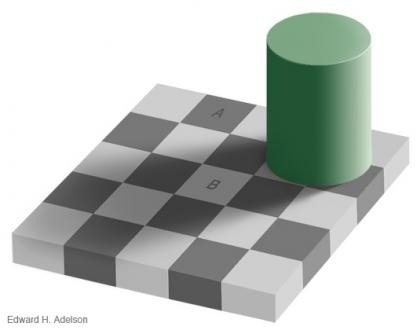
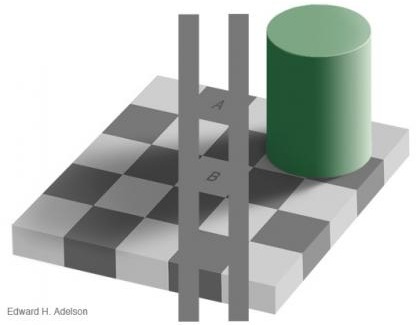
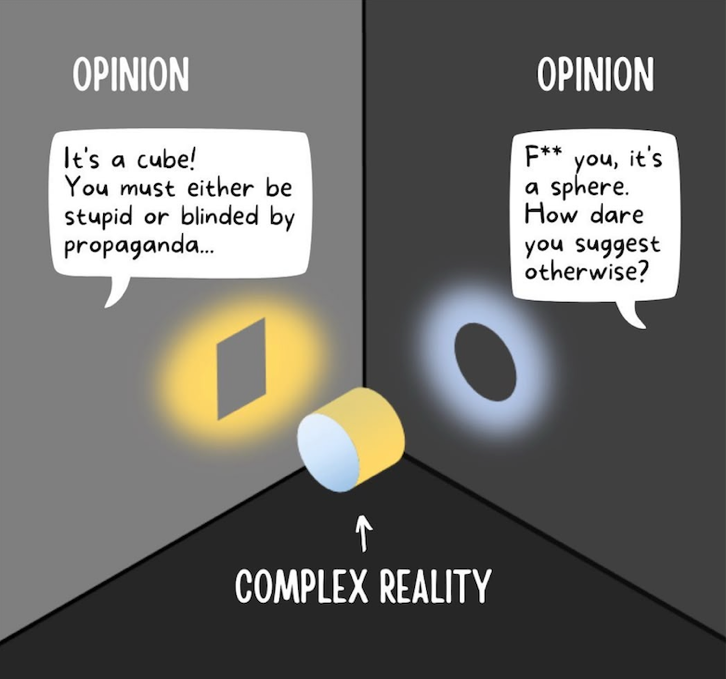
c) Insufficient observation, incorrect conclusions: This is by far the most common scenario in my experience. What we observe is usually a small part of something larger and more complex than is possible to understand without significant effort or study. Much like the proverbial blind people feeling a part of an elephant, we may make real but insufficient observations to explain the whole. The problem arises when we start to take the observations too seriously.
Consider a cylinder casting different shadows on two perpendicular walls: someone observing the square shadow may hastily and incorrectly conclude the actual object to be cuboidal. Similarly, someone else may conclude a sphere, looking at the circular shadow. Both are right about what they see, but wrong about a reality that's far more complex than they imagine.
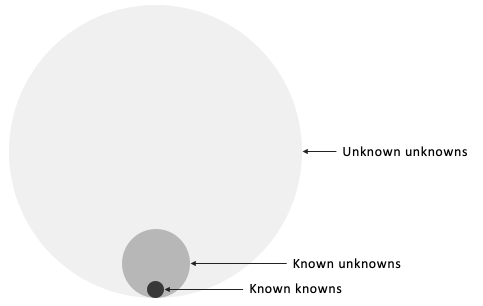
I love how Donald Rumsfeld articulated this in 2002 with his known knowns, known unknowns and unknown unknowns. Unfairly ridiculed at the time by some, he gave us a memorable articulation of how to look at uncertainty and epistemic deficit. We build opinions about how something works, through the lens of what we know, or have experienced. The average human experience however is extremely small relative to all that can be experienced. When faced with a question, our brains quickly build convincing explanations based on what little we know (known knowns), lending our opinions the garb of rationality. But the optimal answer often lies in information we know exists but can't access, or more often, in information we don't even know exists.
Take another example — western society remembers Winston Churchill as a hero. That's one perspective. His reputation tends to take a very different color in India, where his role in the 1943 Bengal famine — diverting Indian resources to the imperial war effort and post-war stockpiles over famine relief — led to the deaths of roughly 3 million Indians. Genghis Khan is another historical figure with extremely different interpretations: a symbol of conquest and slaughter to some, nation-builder to others. The same person can occupy very different moral positions depending on which history one inherits. Philosophically, this echoes Friedrich Nietzsche's perspectivism: the idea that what we call 'truth' is often shaped by standpoint, interest, history, and interpretation. A single view rarely exhausts reality.
What it does not explain sufficiently to me however, is why we get emotionally attached to our opinions, and why it is so uncomfortable for us to consider the possibility that we are wrong. It may have something to do with us merging our identities with our opinions — a threat to our existing view may be subconsciously perceived as a threat to our identity. The entanglement between opinion and identity may become especially severe in case of subjects like morality.
2. Confidence vs competence
Confidence is much celebrated and valued as a quality in society. We are drawn to those who project confidence and conviction, and are conditioned to dismiss those who sound unsure. Psychologically, this may be because our brains use confidence as a shortcut to gauge competence. The problem is that displaying confidence is easy, but gaining competence is hard.
Justin Kruger & David Dunning in their often-cited paper from 1999, somewhat controversially proposed that people with limited knowledge or competence tend to greatly overestimate their own abilities, to the point of confidence, while those with greater competence tend to underestimate themselves. Nassim Taleb in his book Skin in the Game further critiques experts, bureaucrats and consultants who confidently propagate solutions, theories and policies from a distance without having significant actual operating experience in the subject and as a result don't bear the real-world consequences of their ideas, sometimes causing widespread, unintended harm. Contrary to this archetype are researchers, entrepreneurs or craftspeople with years of chasing an idea, failure, applied expertise and honing of skills.
Operating anyway
None of this is an argument for not having opinions. Decisions still have to be made, mostly on incomplete information, and "it's complicated" is not a strategy. The lessons for me are to:
- Remain humble about one's opinions, and treat them as working drafts
- Acknowledge that one could be wrong or be missing information
- Welcome disagreement — it is free information
- Be on the lookout for new evidence that can improve one's understanding
- Not mistake confidence for competence — either in oneself or others. Demonstrated experience, skin in the game, and a track record of learning from reality are better proxies.
Postscript, July 2026 — I wrote this essay in October 2025. Since then, I've noticed that LLMs fail in strikingly human ways: they too construct confident, fluent explanations, and they don't know what they don't know. No single mind — human or machine — completely escapes the burden of its perspective. These thoughts led me to build LaserChat in 2026, a tool that gives users a council of LLMs with distinct thinking styles that challenge each other to provide higher quality responses compared to a single LLM. This is my attempt to make disagreement and perspective-taking integral to AI supported decision-making.